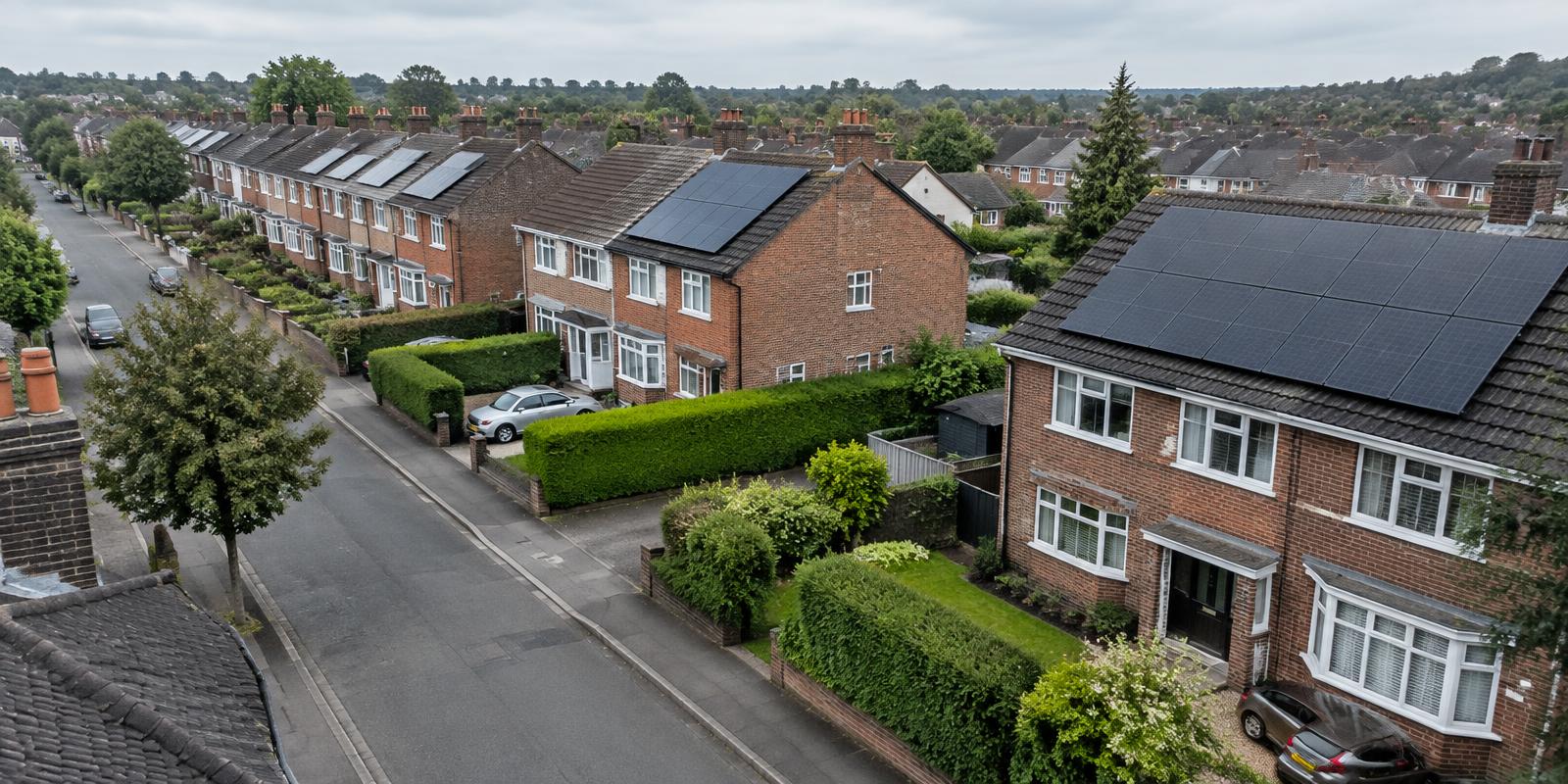
Short answer: group-buying schemes like Solar Together are a legitimate way to get solar at a competitive price, and for some households they're the right choice. But they are generally built around a standardised, lowest-bid model — and we feel that model can have real trade-offs in equipment quality, system design and aftercare that the marketing material doesn't spell out.
We're a private installer, so read this knowing our bias. We'll try to be fair to the schemes anyway, because the honest answer is more useful to you than a sales pitch in either direction.
What Solar Together actually is
Solar Together is a group-buying scheme that partners with local councils across the UK, including in Hertfordshire and Essex. Homeowners register their interest for free. The scheme then runs a competitive auction among pre-vetted installation companies, and the winning bid sets a fixed price per panel — typically with add-on options for battery storage and EV charging. Everyone who registered gets the same catalogue-style offer: X panels, at £Y per panel, with optional extras.
The model has genuine strengths. Collective buying does drive panel prices down compared with an un-shopped-for quote. The vetting process filters out the worst cowboys. And for homeowners who find the solar market bewildering, having a council-endorsed scheme make the choice for them is worth something on its own.
What the reviews actually say
Reading through Solar Together's Trustpilot reviews and independent discussion on forums like MoneySavingExpert and PistonHeads, four themes come up repeatedly. Worth saying upfront: reviews from 2025–2026 trend noticeably more positive than the wave of one-star reviews from 2022–2023, so treat these as things to ask about rather than a guaranteed experience — but they're common enough, and serious enough, to be worth asking about.
Equipment specced to hit the auction price, not your roof. This isn't just customer opinion — an independent review commissioned in connection with the Solar Together London scheme found that some of the equipment iChoosr specified, including inverters, was below what you'd typically expect for a domestic installation, and warned this could mean more warranty claims down the line. When the winning bid is decided by price per panel, the equipment has to hit a cost target — that's a structural feature of the model, not a one-off failure.
Spec confirmed after you've committed, not before. More than one buyer has described accepting a headline price, paying a deposit, then only finding out the actual specification — and how much choice they had over components — at the survey stage that follows. If you want to compare exact panel and inverter models before you pay anything, this process makes that difficult.
Lead times measured in months, sometimes over a year. Each registration round typically stays open for two to three months, and the scheme's own target is to complete installations within six months of the last person accepting their offer — so signing up in spring can mean a winter installation, if everything runs to plan. It doesn't always: one buyer's original contracted installer pulled out entirely after more than a year, having taken on more work than they could deliver, and the replacement installer subcontracted the scaffolding, wiring and panel fitting separately, which brought its own delays and finger-pointing between trades.
Aftercare goes through a call centre, not a person who knows your job. This is the most consistently reported issue across reviews: engineers with no surname or number to call back on, long hold times with no resolution, and — in some of the worst cases — an installer who simply stopped answering, leaving the customer chasing Solar Together's support desk rather than the person who did the work. When something needs fixing two years after installation, you're relying on a support process, not a relationship.
- GLA response to AECOM evaluation of Solar Together London — the primary report itself
- Full AECOM evaluation report (GLA82284)
- London Assembly Environment Committee transcript, 11 July 2023 (iChoosr questioned directly on installer vetting)
- Sunsave.energy overview (registration windows, six-month completion target)
- PistonHeads forum thread (installer pulled out after a year, subcontractor delays)
Group scheme vs bespoke installation: the honest comparison
| Group-Buying Scheme | Bespoke Survey-Led Install | |
|---|---|---|
| System design | Catalogue offer, same or similar spec for every home | Designed around your roof, usage pattern and tariff |
| Equipment | Price-led, typically mid-tier panels and inverters | Specified on merit — e.g. Trina Vertex S+ N-Type panels, Fox ESS hybrid inverters |
| Battery sizing | Optional add-on in fixed increments | Sized to cover your evening usage and Time-of-Use tariff window |
| Survey | Remote assessment, brief pre-install check | Free in-person survey by a master electrician who designs the system |
| Pricing | Competitive per-panel auction pricing | Fixed-price quote, fully itemised after the survey |
| Lead times | Often months after auction rounds | Scheduled directly with your installer |
| Aftercare | Via the scheme's support process | Direct line to the electricians who actually installed it |
| MCS certification | Yes — scheme installers are MCS registered | Yes — handled as part of every JJB Volta installation |
Notice what's not different: safety standards and certification. Both routes use MCS-certified installers, and both qualify you for the Smart Export Guarantee and 0% VAT when battery storage is installed alongside solar. The difference is in optimisation and accountability, not legitimacy.
Where the equipment difference shows up on your bill
A solar system is a 25-year asset. The equipment choices that seem like small print at quotation stage compound over decades.
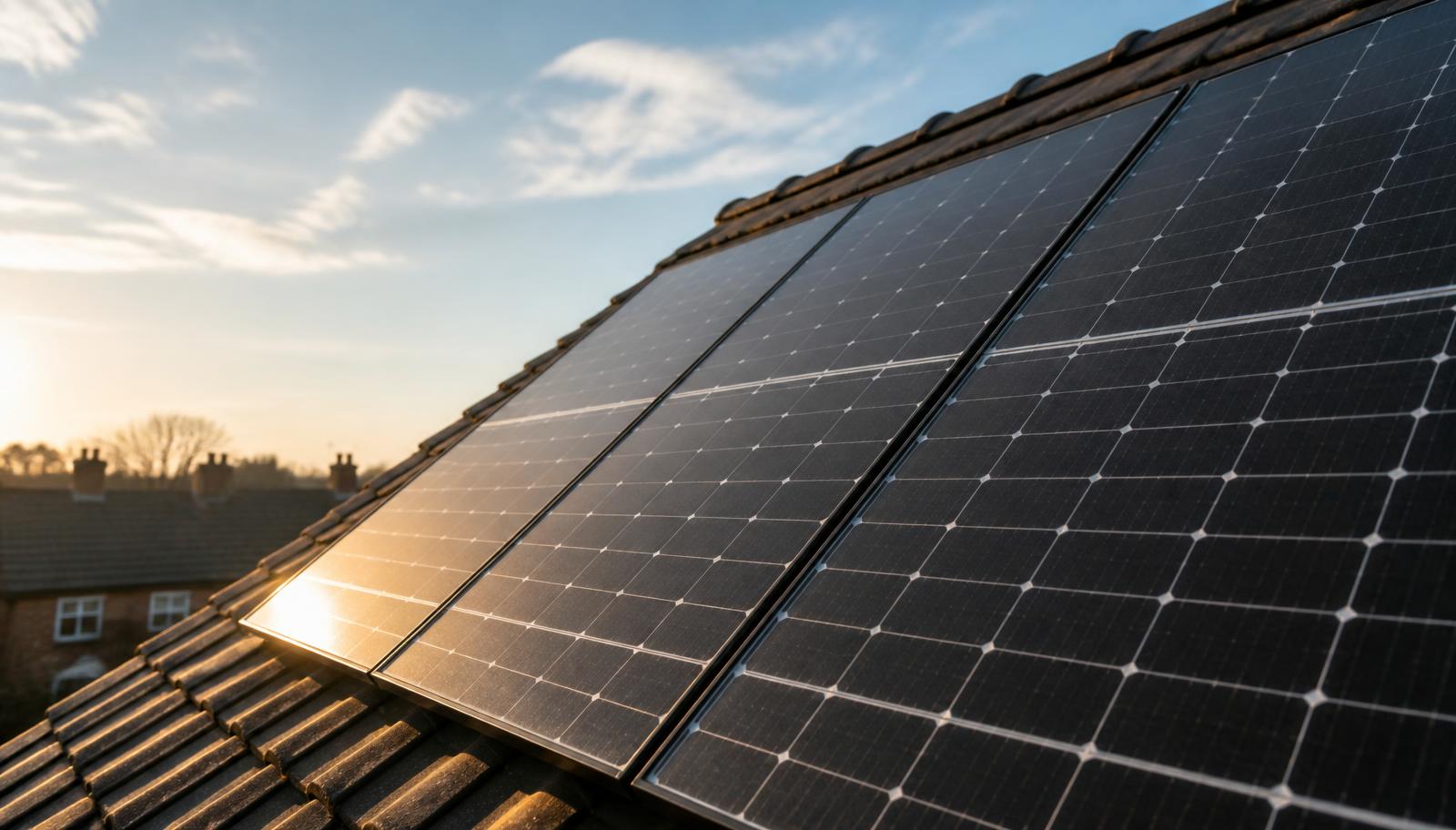
Panels. We specify Trina Vertex S+ N-Type panels (450–500W, up to 22.5% efficiency, 25-year performance warranty). Higher efficiency means more generation from a limited roof area — which matters most on exactly the smaller roofs where a low per-panel price looks most attractive.
Inverters and batteries. A price-led auction bid rarely includes a hybrid inverter and a properly sized battery. Yet for most homes we survey, the battery is where the savings live: charged by solar surplus in summer, and charged overnight at 7–8p/kWh on a Time-of-Use tariff in winter, discharging during the 4–9pm peak at 24p+. A 10.36kWh Fox ESS EP11-H battery with self-heating is specified to cover 5–7 hours of real evening usage — not offered as a one-size add-on module.
When a group-buying scheme is the right choice
We'll say this plainly, because it's true: some households should use Solar Together or a scheme like it.
- You're on a tight budget and the headline price is the deciding factor. A standard system at a low price beats no system.
- You have a straightforward, south-facing roof, no shading, and a simple daytime-heavy usage pattern — the cases where a standard spec genuinely is adequate.
- You don't want to arrange your own survey, compare quotes, or make equipment decisions — and you're comfortable accepting the spec as offered.
If that's you, register, read the small print on equipment brands and warranty terms before you accept, and check the installation date range offered.
When a bespoke, survey-led installation wins
- Your roof isn't standard — east/west split, partial shading, unusual pitch, or limited usable area where panel efficiency really counts. (South facing matters too)
- You're out during the day, so self-consumption and battery sizing determine your savings, not raw generation.
- You want battery storage that's specified around a Time-of-Use tariff, not bolted on as a catalogue extra.
- You value aftercare from a named, local team — the same master electricians who surveyed and installed your system, reachable by phone.
- You have an EV or plan one — combining solar, battery and EV charging typically saves an additional £400–£600 per year on charging alone.
A group-buy scheme gets you the lowest price per panel. A bespoke installation aims to get you the highest value return per pound over 25 years. Those aren't the same thing.
Questions to ask before accepting any solar offer
Whether it's a scheme offer or a private quote, these five questions separate a good deal from an average one:
- Which panel and inverter brands, exactly — and what are their performance warranties?
- Was this system designed from a survey of my actual roof and usage, or priced per panel from an aerial photo?
- What battery capacity is offered, and does it cover my evening usage on a Time-of-Use tariff?
- Is MCS registration included, so I qualify for Smart Export Guarantee payments?
- Who do I call in year three if something stops working — and is it a person who knows my system?
The bottom line
Solar Together reviews are neither a scam warning nor a universal recommendation. Group-buying schemes deliver real value for straightforward homes on tight budgets. For everything else — non-standard roofs, households who want the battery and tariff strategy done properly, and anyone who wants the installer to still know their name in five years — a free, no-pressure survey with a local master electrician will nearly always produce a system that earns more over its lifetime.
We survey homes across Hertfordshire, Essex and surrounding areas, we'll model your actual roof and usage, and if a group scheme you are also looking at is genuinely the better fit for your situation and budget, we'll tell you that too.
We're electricians first. JJB Volta is a brand name of JJB Electrical Limited. We design and install solar, battery storage and EV charging systems for homeowners across Hertfordshire and Essex. MCS certified, NAPIT registered, Which? Trusted Trader approved. Every system is survey-designed and backed by a 6-year workmanship guarantee.