Most installers will fit your battery and leave. We explain the tariff. Here's what you need to know.
What "time-of-use" actually means
A standard electricity tariff charges you the same rate 24 hours a day — currently around 24–27p/kWh under the Ofgem price cap. It doesn't matter whether it's 2am on a Tuesday when demand is low and half the country's wind turbines are running flat out, or 6pm on a cold January evening when every gas-fired power station in the country is online. You pay the same.
A Time-of-Use (ToU) tariff reflects what electricity actually costs to produce at different times of day. Overnight, when demand is low and renewable generation is high, electricity is cheap. During the 4–7pm evening peak, when demand spikes and gas plants are ramping up to meet it, electricity is expensive.
For a household without a battery, this pricing structure is either neutral or mildly inconvenient — you have limited ability to shift when you use electricity. For a household with a battery, it's a financial opportunity. Your battery charges overnight at the cheap rate and discharges during the expensive peak. You've effectively bought electricity in bulk when it was cheap and used it when it would have cost three to four times more.
That's the arbitrage. £150–£300 in annual savings for battery owners, before a single solar panel contributes anything.
The current rate landscape
The three tariffs worth knowing about
There are several ToU tariffs available in the UK. These are the three that matter most for battery and solar households in 2026.
Octopus Go — the simplest starting point
Octopus Go gives you a fixed overnight rate of 7–7.5p/kWh between 23:30 and 05:30. Outside that window, you pay the standard variable rate — currently around 27–32p/kWh.
For battery owners, this is the easiest win available. Set your battery to charge during the overnight window. It fills up at 7.5p/kWh. During the 4–8pm evening peak when the grid is most expensive, your battery discharges and powers your home. You've replaced 27–32p electricity with 7.5p electricity.
Most drivers and battery households save £400–£600 per year compared to a standard electricity tariff on Octopus Go. The switch costs nothing and takes about 10 minutes.
Octopus Agile — for those who want to go further
Agile is more sophisticated. Rather than fixed overnight rates, it reflects wholesale electricity prices every 30 minutes — updated the following day at 4pm so you can see tomorrow's rates in advance.
On most days this means overnight rates of 5–15p/kWh. On windy nights when renewable generation is high and demand is low, rates regularly drop below 5p — and occasionally go negative, meaning Octopus pays you to use electricity. During 2025–26, Agile prices dipped below zero 370 times in some regions.
The trade-off is that evening peak rates are also variable and can spike. Agile customers in London were charged 31.35p/kWh during the 6:30–7pm slot on 15 April 2026. A well-managed battery handles this automatically — charged fully overnight, it simply doesn't draw from the grid during the expensive window.
The average Agile customer saved £440 per year compared to a standard tariff, and households with batteries that automate their charge/discharge cycles typically save more.
Octopus Flux — the solar + battery specialist
Flux is designed specifically for households with both solar panels and battery storage. It's structured differently from Go and Agile: rather than just offering cheap overnight import, it also pays a premium rate for electricity you export to the grid during peak hours.
Octopus Flux pays 24p/kWh for peak exports. Here's what that means in practice: your solar generates during the day, charges your battery, and during the 4–7pm peak when grid demand is highest, your battery exports surplus electricity back to the grid at 24p/kWh. You're not just avoiding buying expensive electricity — you're selling it at a premium.
For a well-optimised solar and battery household, Flux can generate meaningful export income on top of the bill savings from self-consumption. Some JJB Volta customers are currently selling back at 27–37p/kWh during peak windows.
How your battery manages this automatically
Here's the part that trips people up when we explain it on survey calls: you don't have to manage any of this manually.
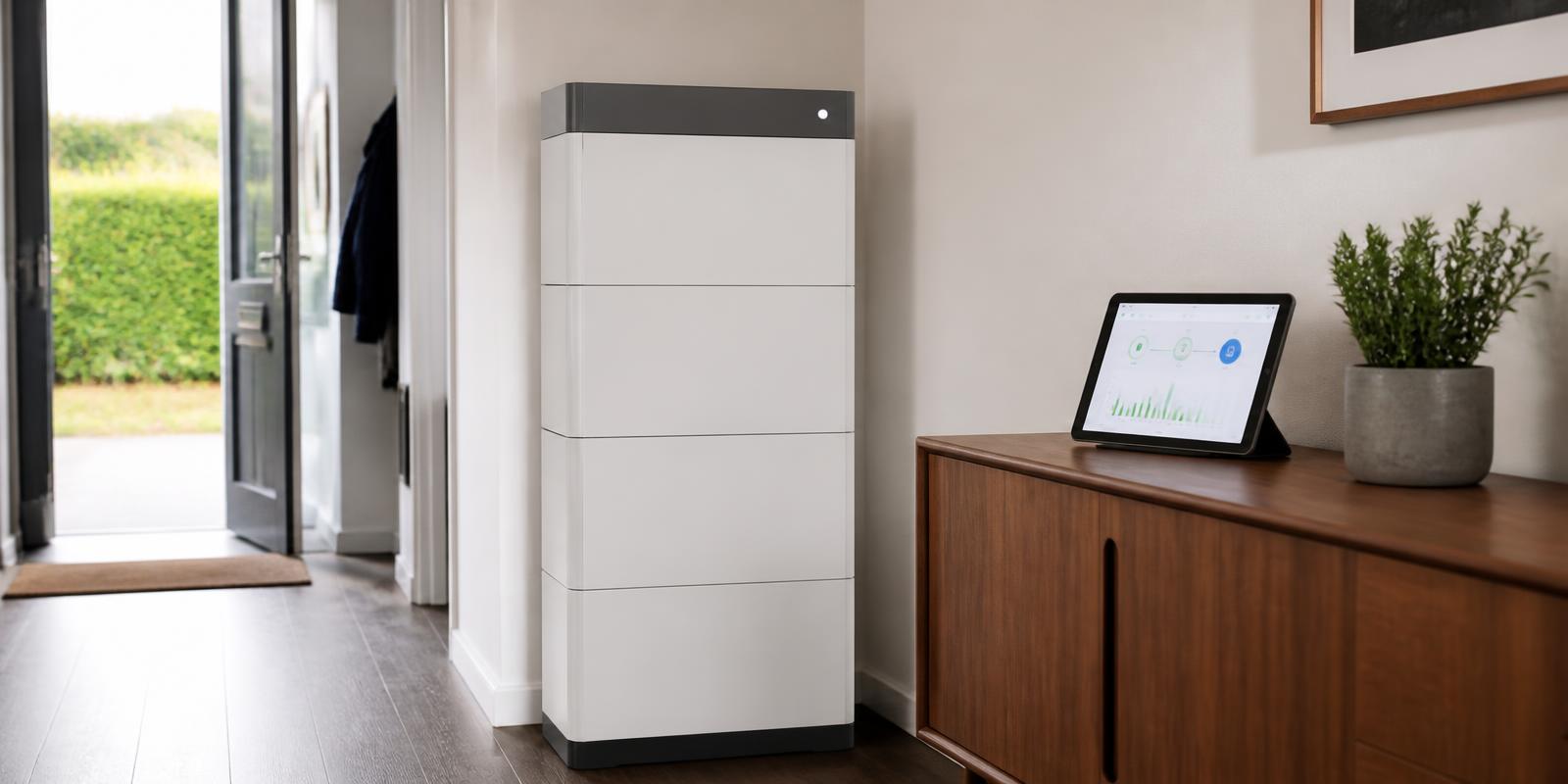
The Fox ESS hybrid inverter we install reads your tariff schedule — either directly via the Octopus API or via a manually set charging window — and handles charge/discharge automatically. You set it up once during commissioning. After that:
- The battery charges overnight during the cheap window.
- During the day, solar generation either charges the battery or powers the home directly.
- During the evening peak, the battery discharges to power the home.
- If the battery runs low, the system draws from the grid — but only what's needed.
You see all of this in the Fox ESS app in real time. Every unit charged, every unit discharged, the current battery state, and your running savings. It becomes genuinely interesting to watch once you understand what you're looking at.

The tariff question we ask on every survey
When we visit a property for a solar or battery survey, one of the first questions we ask is: what tariff are you currently on?
The reason: if you're on a standard flat-rate tariff and you're planning to install battery storage, the tariff switch should happen at the same time as the installation — or before it. A battery on a flat-rate tariff saves money by increasing self-consumption of solar. A battery on an Octopus Go tariff does that and arbitrages the overnight rate every single day of the year, including in December.
The difference in annual savings can be £300–£500. Over 10 years, that's £3,000–£5,000 — from a decision that costs nothing to make.
We make sure every customer leaves their survey call knowing which tariff is right for their setup, how to switch, and how to configure their battery to take full advantage of it. It's not complicated. But it does matter — and most installers don't have the conversation.
A real example from a recent installation
A customer in Hertfordshire we installed a Fox ESS battery system for in early 2026 had previously been on a standard variable tariff. Their solar panels were generating well in summer but the battery wasn't making much of a difference in winter — because without a ToU tariff, there was no overnight arbitrage to capture.
We walked them through switching to Octopus Go at commissioning. Within the first full billing cycle, their electricity costs had dropped materially. By spring 2026 they had switched to Octopus Flux and were actively monitoring export opportunities during the 4–7pm peak window, selling back at rates significantly above what they were paying overnight.
The battery hardware hadn't changed. The solar array hadn't changed. The tariff had changed.
What this means if you're considering battery storage
The financial case for battery storage in 2026 is strong — but it depends on the tariff running underneath it. Panels on the roof, battery on the wall, and a standard flat-rate tariff is a system that's running at perhaps 60% of its financial potential.
The same system on Octopus Go is running at closer to 90%. On Flux, for solar households, potentially 100% or better once export income is factored in.
If you're in the process of deciding whether battery storage is worth it for your home, factor the tariff into the calculation from the start. We include it in every financial projection we produce — with the saving shown at standard rate, at Octopus Go, and at Flux where relevant.
If the numbers work with a standard tariff, they work very well on a ToU tariff. If they only work on a ToU tariff, that's worth knowing before you commit.
Either way, we'll tell you the truth.
We install solar panels, battery storage and EV charging systems for homeowners across Hertfordshire and Essex. MCS certified, NAPIT registered, Which? Trusted Trader approved. Every system is survey-designed, properly commissioned with the right tariff in place, and backed by a 6-year workmanship guarantee.